
Aptitude — an untimed capability assessment that shows its working
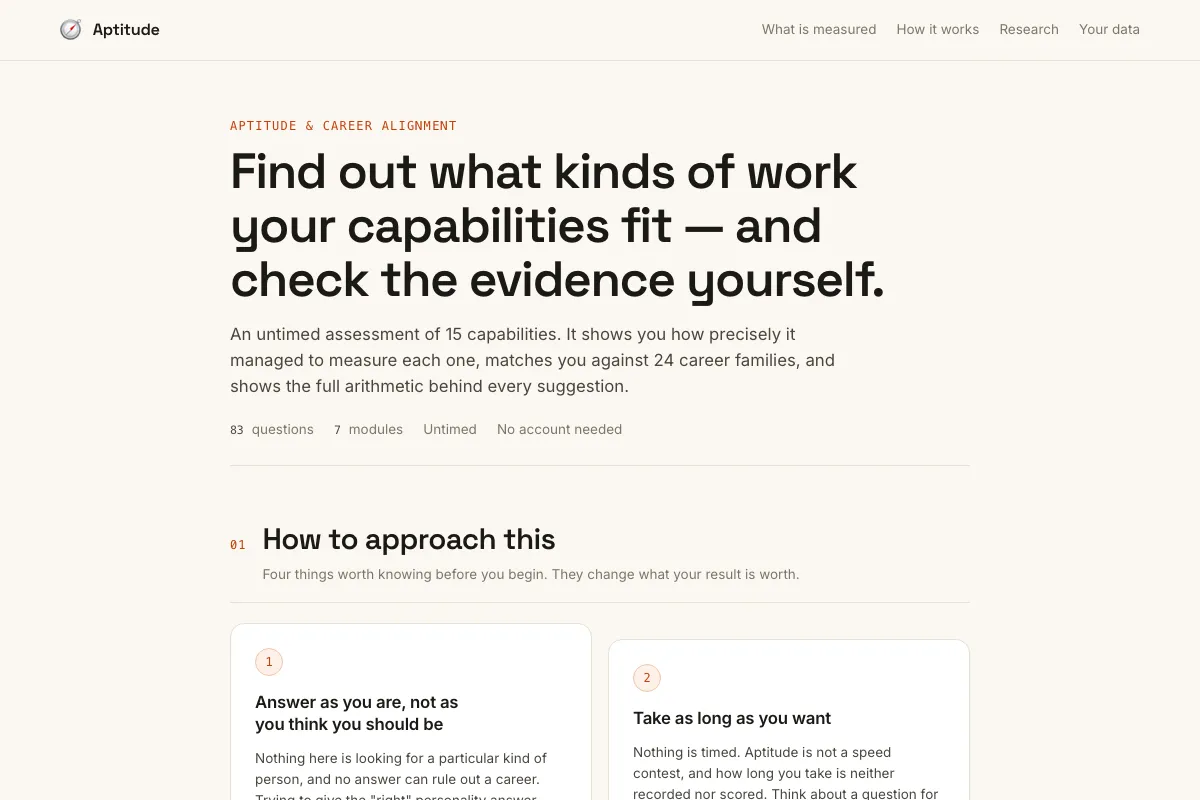
Aptitude is a free web app that gives you one untimed assessment — 83 questions across seven modules — and returns a report in two modes. The simple mode states the result in plain language with no numbers. The detailed mode shows every capability with its uncertainty interval, the matching career families, and the full arithmetic behind each match. Nothing is timed, no account is needed, and everything is scored in your browser.
The problem people live around
Career tests hand back a type, a three-letter code, or a ranked list, and never show where any of it came from. You cannot tell how well a trait was actually measured, why one job ranks above another, or which parts of the result would move if you learned something. So the output has to be taken on trust — and most of it does not deserve that trust.
What Aptitude makes simpler
- Reading your result at the depth you want — plain language with no numbers, or the full capability map with intervals and arithmetic.
- Judging how much any single score is worth, because a poorly-measured capability visibly looks poorly measured.
- Understanding a career match, because the chart shows both what your score contributed and what it left on the table.
- Separating what is trainable from what is not, since personality is never presented as something to fix.
- Taking it on your own terms — untimed, one question at a time, resumable tomorrow from the same place.
What you can do now that was harder before
You can see not just which kinds of work line up with your capabilities, but exactly how each suggestion was calculated, how precisely each capability was measured, and which parts of the result would change if you trained a specific gap.
How it works
One fixed assessment, the same for everyone: 83 questions across seven modules, covering reading and reasoning, working with numbers, patterns and rules, everyday work materials, how you tend to work, situations at work, and behavioural tasks. Questions are shuffled within each module, which changes nothing about the result because the scoring is order-independent. Nothing is timed and there is no clock on screen.
Responses are scored with an item response model that produces an estimate and an uncertainty interval for each capability, not just a number. That uncertainty is carried all the way through: career families whose fit falls inside the leader's 95% interval are grouped together rather than ranked against each other, because the data does not support separating them. Only capabilities measured well enough for the job affect the ranking; the beta and experimental ones are labelled and excluded.
There is no backend. No account, no network call, no model call anywhere in the scoring path. Your progress is kept in your own browser so a refresh or a lost connection does not cost you the session, and the same answers always produce the same report.
What the AI does, and doesn't
None. There is no AI in Aptitude — not in scoring, not in matching, not in writing the report. The engine is a published statistical model, the 24 career families are structured expert judgment written down in advance, and both entry points are pure functions of your answers. Nothing you type is sent anywhere to be interpreted, and no part of the result is generated per visit.
Evidence and sources
- The item parameters are engineering placeholders rather than values estimated from a real sample, and the role weights have no criterion validation.
- Item calibration, DIF analysis, cross-group validation and criterion validation have not been done. The report says so on its own measurement-notes page rather than leaving it to be discovered. As of September 2026
- No global percentiles are reported for any capability.
- This item bank has no measurement-invariance evidence, so every trait is treated as local-norm-only or experimental. Comparing your score against a population would imply a claim the data cannot support. As of September 2026
Limitations
Knowing where a tool stops is what makes the part that works trustworthy. These are written before launch, not after complaints.
- It is calibrated on placeholder parameters. The structure of the result is sound; the exact numbers are not yet normative, and the report states this plainly.
- It cannot measure intelligence, diagnose anything, or predict your income.
- It measures a narrow set of capabilities on one day. A bad day is a real limit, not a personality.
- It does not tell you what to do next, or which employer to approach. It names families of work, not jobs.
- It has no adaptive question selection, because the bank is not calibrated well enough for that to mean anything.
- A low-quality session is not silently scored down — it is reported as not having produced a reliable profile, with the offer to retake.
Who it's for
- People choosing a direction who want to see the reasoning rather than be handed a verdict.
- Anyone who has taken a career test before and distrusted it for refusing to show its working.
- People who want to know which gaps are trainable and what closing one would actually change.
- Not a fit for hiring, screening or selection — it is built for the person taking it, not for someone assessing them.
What it does not replace
A careers adviser, a psychologist, or a properly validated selection instrument. Aptitude shows you one structured, transparent reading of your capabilities and what it lines up with. It does not decide anything about you, and it should not be used to decide anything about anyone else.
Why we built it this way
Most career tests are unfalsifiable by design. They hand back a label with no interval, no weights, and no way to ask why — which makes the confident ones and the useless ones look identical from the outside.
Aptitude inverts that. The uncertainty is drawn, not buried: a poorly-measured capability looks poorly measured, and families that cannot be honestly separated are grouped instead of ranked. The parts of the method that are not finished — calibration, validation, cross-group checks — are named in the report rather than left for someone to discover later. A result you can argue with is worth more than one you have to believe.
Questions about Aptitude
Is Aptitude timed, and do I need an account?
It is untimed and there is no account. Nothing on screen counts down, how long you take is neither recorded nor scored, and choosing an answer simply moves you to the next question. Your progress is saved in your own browser as you go, so you can close the tab and carry on tomorrow from the same place.
Can a wrong answer on the personality questions rule out a career?
No. Personality never disqualifies anything in Aptitude. Hard requirements are limited to capability minimums and credentials, and even a failed one changes the eligibility statement while leaving the alignment score visible. Answering as you actually are, rather than as you think you should be, is what makes the result worth anything.
How accurate are the scores?
Structurally sound, numerically provisional — and the app says so itself. The item parameters in this version are engineering placeholders rather than values estimated from a real sample, and the career weights are expert judgment with no criterion validation yet. Every capability is shown with its uncertainty interval, and no global percentiles are reported, because the evidence to support them does not exist yet.
Where do my answers go?
Nowhere. There is no backend, no account and no network call in the scoring path. The assessment is scored entirely in your browser, your progress lives in that browser's storage so a refresh does not cost you the session, and clearing it removes the session completely.