
Elevate — the seven best books on a topic, one idea at a time
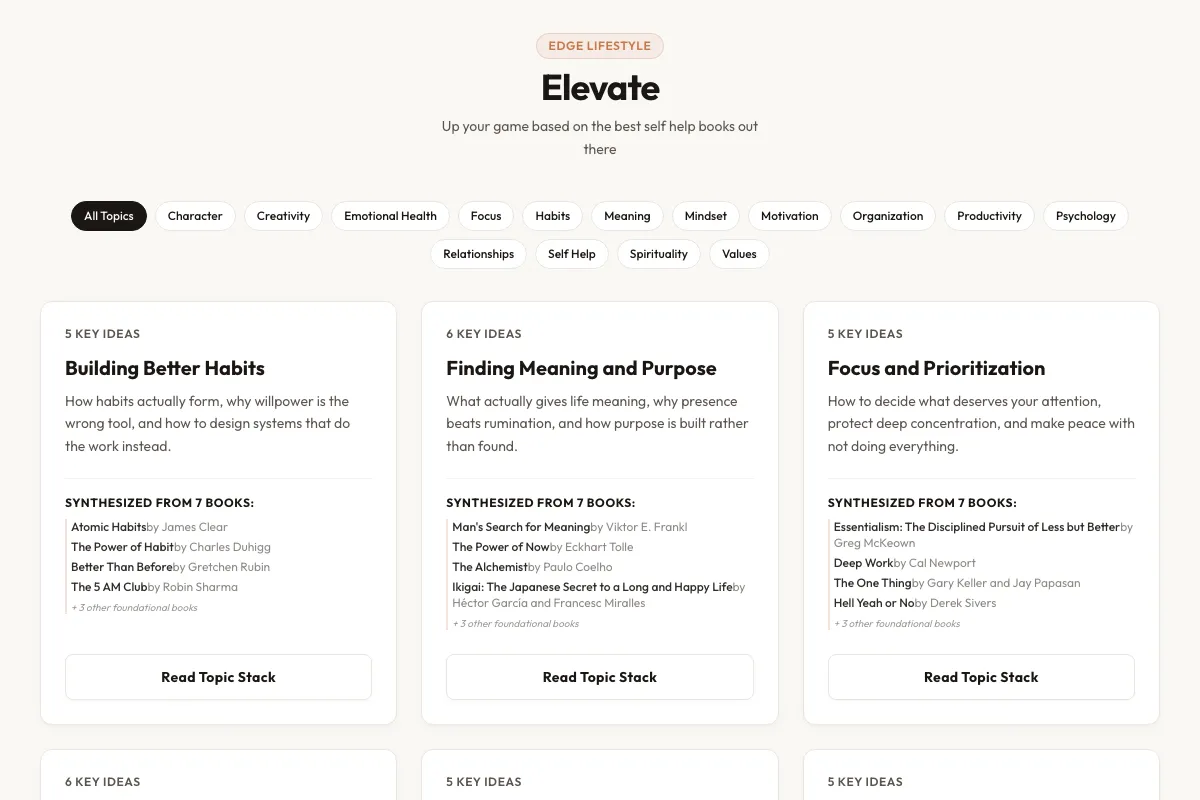
Elevate is a free web app that turns a topic into the key ideas from seven curated books, presented one at a time as a stack of cards. Every idea follows the same five parts — why it matters, what it is, how to use it, a real-life example, and the evidence behind it — and when the evidence is thin, the card says so instead of asserting the claim anyway. There are no streaks, no points, no notifications and no paywall.
The problem people live around
Wanting to get genuinely better at something — focus, habits, communication — and finding two bad options. The honest answer is spread across seven books you realistically won't finish, or it's been compressed into summaries shallow enough that a blog post would have done the same job. Both leave you recognising ideas rather than being able to use them, and neither tells you which claims actually hold up.
What Elevate makes simpler
- Understanding a topic rather than a book, since one topic draws on seven instead of making you stitch seven summaries together.
- Knowing what to actually do, because every idea has a fixed “How To Use It” section in the same place every time.
- Judging what to trust, because every idea ends with an Evidence section — including when the honest answer is that the evidence is thin.
- Going to the source, because each idea names the books it came from.
- Finishing, because the stack of cards is bounded and countable rather than an endless feed.
What you can do now that was harder before
You can get the substance of seven books on one topic — deduplicated, attributed to their sources, and each marked with how strong the evidence behind it is — in an evening rather than a year.
How it works
Topics are curated by a person — initially Zankar — not auto-scraped or auto-generated. Seven books are chosen for a topic, ideas that repeat across them are merged and attributed to every source that makes the point, and the result is written into the same five-part structure every time. That structural consistency is itself the feature: you always know where the “how do I actually use this” part is.
The Evidence section is mandatory rather than optional. If solid empirical support for an idea doesn't exist, the card states that plainly instead of dressing an anecdote up as a finding.
The reading interface is deliberately calm. Cards are discrete and countable, progress is a thin indicator rather than a score, and finishing a card changes its state quietly — no confetti, no sound, no popup. Nothing in the app is built to bring you back tomorrow.
What the AI does, and doesn't
AI does not choose what you read, in what order, or when. There is no recommendation engine and no personalisation — everyone sees the same curated topics. Where an AI-assisted step is involved in drafting content, it is labelled on the card with a visible reason; the decisions about which books, which ideas survive, and how strong the evidence is are made by a person.
Evidence and sources
- Every key idea ends with an Evidence section, and says so when the support is weak.
- A mandatory section in the content structure rather than an editorial preference: an idea cannot ship without one, and where strong empirical evidence does not exist the card states that instead of asserting the claim regardless. As of July 2026
Limitations
Knowing where a tool stops is what makes the part that works trustworthy. These are written before launch, not after complaints.
- It is not a substitute for reading the books. It tells you which ideas earn your attention and where they came from.
- Coverage is narrow by design — a small number of carefully built topics rather than a large catalogue.
- Seven books per topic is a curator's judgement, not a survey of the field. A different curator would pick differently.
- There are no accounts, so progress lives in one browser and does not follow you across devices.
- No streaks, points, levels, leaderboards or notifications — if external pressure is what keeps you reading, this will not supply it.
Who it's for
- People who want to get better at a specific skill and would rather start from the strongest ideas than the newest book.
- Readers who have bounced off summary apps because the summaries felt shallow or the subscription felt hostile.
- Anyone who wants to know how well-supported an idea is before acting on it.
- Not built for people collecting books read as a score — there is deliberately nothing to score.
What it does not replace
Reading the books, or doing the work. Elevate compresses the map, not the territory: it can tell you which ideas are worth your attention and what the evidence behind them looks like, but the practice that actually changes anything still has to happen away from the screen.
Why we built it this way
Elevate started from a pattern in the complaints about existing summary apps. Across five of the best known, the same objections came up: summaries shallow enough that a blog post would have done, content siloed one book at a time, claims asserted with no evidence behind them, subscription flows that were hard to escape, and streaks engineered to produce guilt.
Each of those became a constraint rather than a feature idea. Depth is enforced by a fixed five-section structure. The silo is solved by making the topic the unit instead of the book. Evidence is a mandatory section that has to admit when it’s weak. The dark patterns are simply absent — there is no payment surface and no engagement mechanic to tune. What’s left is a reading experience that ends, which is unusual enough to be the point.
Questions about Elevate
How is Elevate different from a book summary app?
Most summary apps are book-first: one summary per book, so understanding a topic means reading five of them and stitching the overlap together yourself. Elevate is topic-first. One topic draws on seven curated books, merges the ideas that repeat, attributes each to every source that makes it, and gives you the deduplicated result one idea at a time.
Does Elevate use streaks or notifications to keep me coming back?
No, and that's a deliberate product decision rather than a missing feature. There are no streaks, points, levels, leaderboards or push notifications, and nothing is designed to make you feel behind for missing a day. Progress is a quiet indicator of what you've actually read, and finishing a card changes it subtly — no confetti, no sound, no reward animation.
Is Elevate free?
Yes. There are no payments, subscriptions or paywalls in the app — not a trial, not a locked tier, no upsell wall in the middle of a topic. A genuinely useful free version is treated as a launch requirement rather than a marketing step, so nothing you can see is sitting behind an upgrade prompt.
Where do the ideas and the evidence come from?
From seven books chosen by a person for each topic, read and synthesised rather than scraped. Every key idea ends with an Evidence section naming what supports it, and when strong empirical evidence doesn't exist, the card says so instead of asserting the claim regardless. The books behind each topic are listed on the card.