
PhysioWeb — tap a muscle, get short videos for it
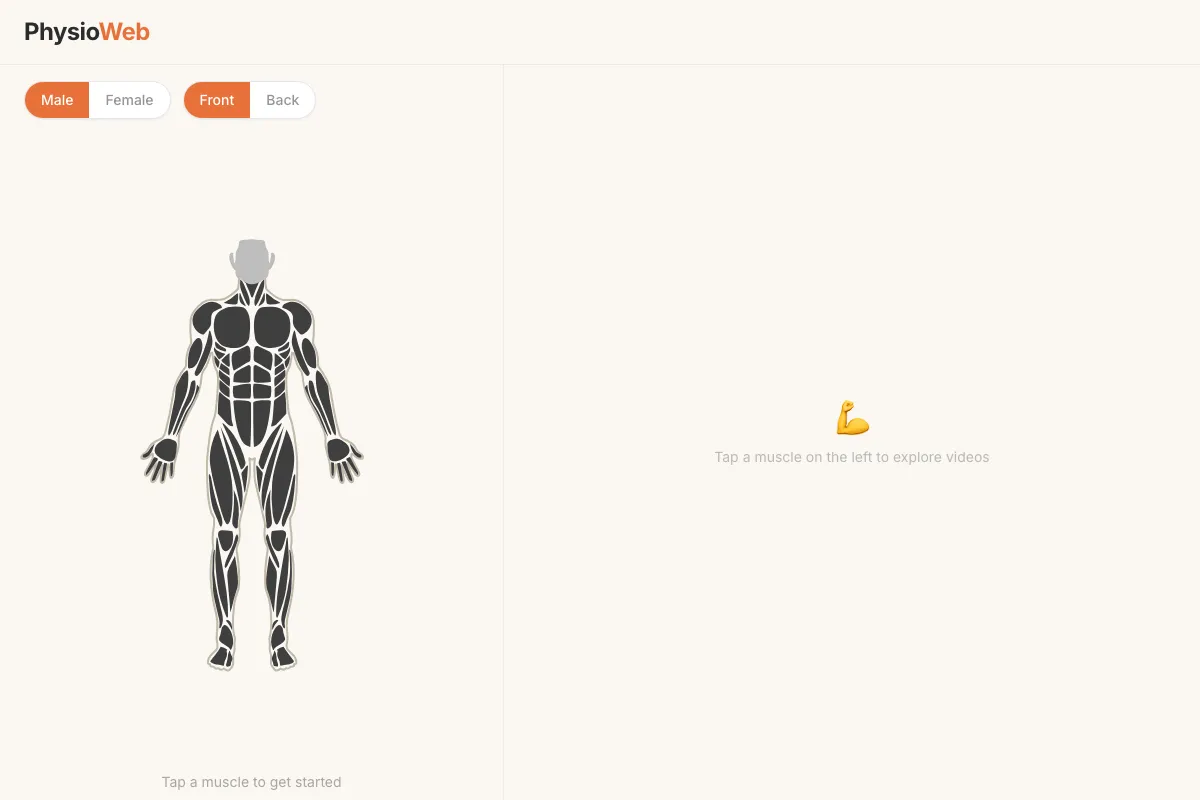
PhysioWeb is a free web app that turns an anatomical body diagram into a way to find short videos for one specific muscle. You tap the muscle on the model, choose one of four intents — strengthen, stretch, massage, or pain relief — and get short videos drawn from a hand-curated list of physiotherapy and training channels. Every muscle-and-intent view is a shareable URL. No account, no signup, nothing to install.
The problem people live around
You wake up with a tight lower back or a sore calf. You don't know what the muscle is called, so you can't search for it precisely. What you can search for returns a wall of text or a page of videos you have no way to judge, and the reliable answer sits inside a profession you'd need an appointment and a fee to reach. Most people guess, or do nothing.
What PhysioWeb makes simpler
- Finding the muscle at all, by pointing at it on a body diagram instead of needing its name first.
- Getting the right kind of answer, because the same muscle returns different content for strengthen, stretch, massage, or pain relief.
- Trusting what comes back, because results are limited to a hand-curated list of physiotherapy, sports medicine and certified trainer channels.
- Staying inside a few minutes, since nothing longer than ninety seconds is returned.
- Sharing exactly what you found, because the whole view — model, side, muscle, intent — is encoded in the URL.
What you can do now that was harder before
You can point at the part of your body that hurts and get short, pre-vetted video for it in under a minute — without knowing its name, and without having to judge a search result you aren't equipped to judge.
How it works
The body diagram is a clickable anatomical SVG, available as male and female models, front and back, switchable without losing the muscle you already selected. Tapping a muscle selects it; the four intent pills then map that muscle to a specific search rather than returning one generic result set. No intent is pre-selected — the choice is always an active one.
Requests go through a small proxy that calls the YouTube Data API, keeps only videos from a manually curated whitelist of around eighty trusted channels, drops anything longer than ninety seconds, and caches the result for a day so repeat visits are fast.
If fewer than three videos survive the whitelist for a given muscle and intent, it relaxes to duration-filtered results rather than showing you an empty screen. That is a deliberate trade-off, and worth knowing about: in those cases you are seeing ordinary search results, not vetted ones.
What the AI does, and doesn't
None interprets your body. There is no model reading your symptoms, no diagnosis, and no personalisation — the app never learns anything about you between visits. The channel list was assembled by hand and is reviewed periodically; the software's only job is to filter and order videos those channels had already published.
Evidence and sources
- Results are restricted to a manually curated whitelist of roughly eighty physiotherapy, sports medicine and certified-trainer channels, capped at ninety seconds.
- The channel list was compiled by hand and is reviewed periodically rather than generated from search ranking. Duration and channel are the only filters; view count is not used as a proxy for quality. As of June 2026
- When fewer than three whitelisted videos exist for a muscle and intent, the whitelist is dropped for that query.
- A documented fallback in the product's own design, disclosed here because it materially changes how much vetting stands behind what you see in those cases. As of June 2026
Limitations
Knowing where a tool stops is what makes the part that works trustworthy. These are written before launch, not after complaints.
- It doesn't diagnose anything. It finds content for a muscle; it cannot tell you why that muscle hurts.
- It can't judge whether a movement is appropriate for your injury, your history, or your current condition.
- It can't verify that a technique shown in a video is right for your body — curating channels raises the floor, it does not guarantee the ceiling.
- In the fallback case described above, results are filtered only by length, not by channel.
- It has no account, no saved history and no notifications. Nothing about your session is kept.
Who it's for
- People with everyday stiffness or soreness who want somewhere sensible to start.
- Anyone who knows where it hurts but not what it's called.
- People between physiotherapy appointments looking for short, reputable material.
- Not for anyone with acute injury, persistent pain, numbness or weakness — that needs a clinician, not a video feed.
What it does not replace
A physiotherapist, a doctor, or a diagnosis. PhysioWeb is a faster route to reputable general content about a muscle you have already identified. It has no idea what is actually wrong with you, and persistent pain, numbness, weakness, or anything following an injury should go to a clinician.
Why we built it this way
The gap here isn’t information. There is more physiotherapy content online than any clinic could produce, and most of it is free. What’s missing is a way in for someone who can’t name the thing they’re looking for and can’t tell a good result from a confident one.
So the entry point is the body itself. Point at the place, say why you’re asking, and get short material from channels that were checked before you arrived. The design is deliberately warm rather than clinical, because the people using it are uncomfortable and slightly worried, not clinicians reading a chart.
Questions about PhysioWeb
Do I need to know the name of the muscle?
No — that's exactly why the body diagram exists. You point at where it hurts or where you want to work, on a male or female model, front or back, and the app resolves it to a muscle for you. The name appears once you've tapped it, so you pick up the vocabulary on the way rather than needing it beforehand.
Where do the videos come from, and how are they filtered?
From YouTube, but never from an open search. Around eighty physiotherapy, sports medicine and certified-trainer channels were curated by hand, and normally only videos from inside that list appear. Anything over ninety seconds is dropped. If fewer than three videos pass the filter for a muscle and intent, the whitelist is relaxed rather than leaving you with nothing.
Can PhysioWeb tell me what's wrong with me?
No. It doesn't diagnose, assess or treat. It's a fast way to find short, vetted content for a muscle you have already identified as sore or worth working on. Persistent pain, numbness, weakness, or anything following an injury is a conversation for a physiotherapist or a doctor, not a video feed.