
GymBuddy — pick a muscle, get the right exercise
GymBuddy is a free web app that helps gym beginners find the right exercise without knowing a single machine name. You pick the muscle you want to work — described in everyday language rather than anatomy terms — and GymBuddy shows the exercises that train it, each with a short demonstration video from a hand-picked list of trusted channels. You can build a list and export it as plain text before you go. No account, no tracking, nothing stored off your device.
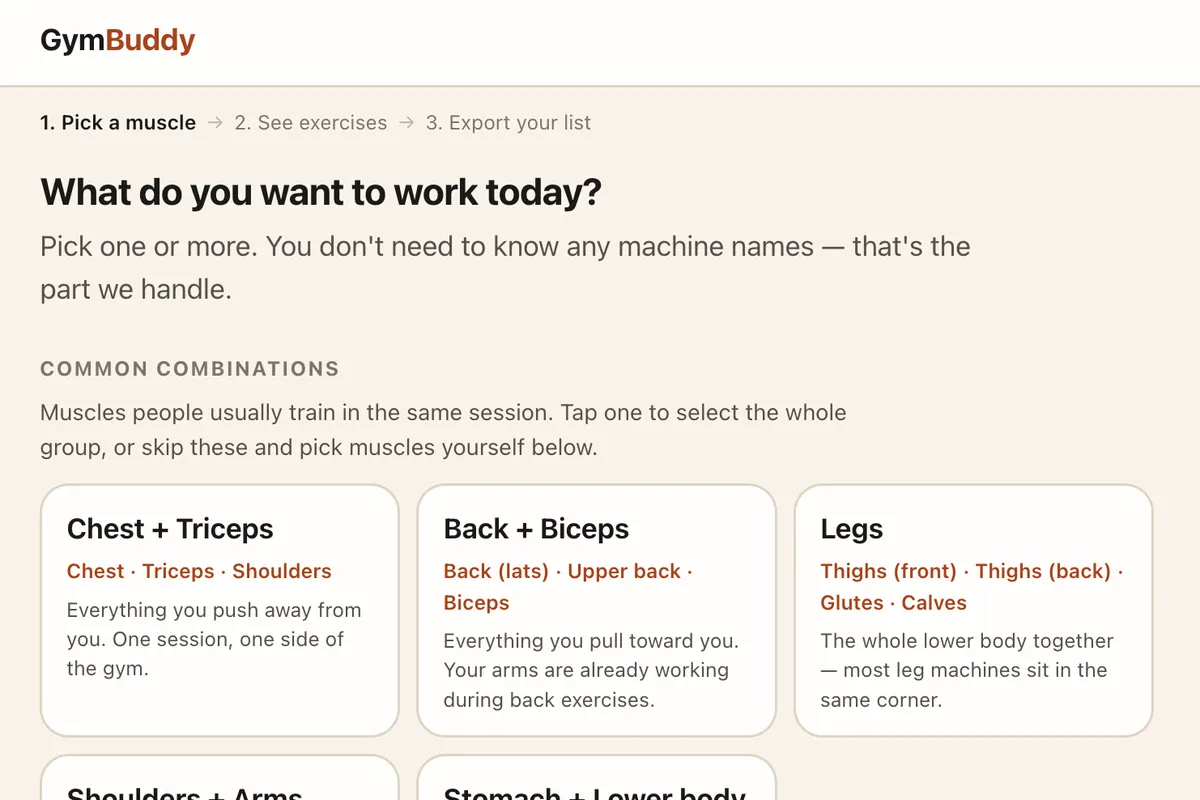
The problem people live around
Walking into a gym for the first time, the barrier isn't fitness — it's vocabulary. You know you want to work your arms. The equipment has names nobody taught you, the labels assume you already know them, and asking costs something in a room full of people who look like they don't need to. So people either copy whoever is nearby, or stay on the treadmill.
What GymBuddy makes simpler
- Finding an exercise by the body part you want to work, instead of by equipment you can't name.
- Understanding what a muscle is, in everyday language — “the muscle caps on top of your arms”, not “deltoids”.
- Judging what an exercise actually looks like, through short demonstrations from channels chosen in advance.
- Locating the machine on the gym floor, because the page shows you the machine as well as the movement.
- Carrying a plan in, by exporting your chosen exercises as plain text into Notes or WhatsApp.
What you can do now that was harder before
You can walk into an unfamiliar gym knowing which exercises train the muscle you came for, and what each one looks like performed — without naming a single machine or asking anyone.
How it works
You select a muscle or a common pairing like Chest + Triceps, and GymBuddy renders the exercises mapped to it along with their demonstration videos. That mapping is a fixed dataset built by hand and shipped with the app — nothing is generated per visit, and nothing you tap is sent anywhere to be processed.
The videos are not ranked by YouTube's own metrics. A set of trusted gym-content channels was picked first, and only videos from inside that list can appear. View counts and subscriber numbers measure how far a video travelled, not how good the instruction is, so they aren't used as the filter.
Your selected list lives in your browser until you export it as text. There is no account, no analytics following the session, and video embeds load through YouTube's youtube-nocookie.com domain.
What the AI does, and doesn't
None. There is no AI in GymBuddy at any point — not in the muscle-to-exercise mapping, not in which videos you see, not in the order they appear. The mapping is a hand-built dataset shipped with the app and the channel list was chosen by a person in advance. Nothing you tap is sent anywhere to be processed, scored, or learned from.
Evidence and sources
- Videos come only from a hand-picked list of channels, never from an open YouTube search.
- The channel whitelist was assembled manually before launch. Raw view counts and subscriber numbers are deliberately excluded as quality filters, because they measure how far a video travelled rather than whether the instruction in it is sound. As of August 2026
Limitations
Knowing where a tool stops is what makes the part that works trustworthy. These are written before launch, not after complaints.
- It isn't a training programme. It answers “what do I do for this muscle”, not “what should my week look like”.
- It can't tell you whether an exercise is safe for your body, your history, or an injury you're carrying.
- It doesn't verify technique. Channels are chosen by hand, but appearing on a good channel is not the same as demonstrating form that's right for you.
- It doesn't identify machines from a photo — you start from the muscle, not from the equipment in front of you.
- Coverage is limited to the muscles and exercises in the shipped dataset. It is not an exhaustive exercise library.
Who it's for
- People in their first weeks at a gym, who know what they want to work but not what anything is called.
- Anyone returning after a long break, to an unfamiliar gym with unfamiliar equipment.
- People who would rather not ask staff or strangers, for whatever reason.
- Not built for experienced lifters — if you already know the equipment and want programming, sets and progression, this is the wrong tool.
What it does not replace
A coach, a training programme, or a physiotherapist. GymBuddy tells you what trains a muscle and what the movement looks like. It does not decide what you should be doing, how much of it, in what order, or whether any of it is appropriate for your body.
Why we built it this way
The fix wasn’t more content — there is already more gym instruction online than anyone could watch. It was inverting the entry point. Start from the part of your body you want to work, in words you already use, and let the app do the translation into equipment and movement.
Everything else follows from that one decision, including what got left out. There are no streaks, no notifications and no reason to open it tomorrow, because the goal is one useful session rather than a habit. It is built for low-attention use between sets, on a phone, in a room where you would rather not be seen reading a manual.
Questions about GymBuddy
Do I need to know machine names to use GymBuddy?
No — that is the entire point of it. You start from the muscle you want to work, described in everyday language, and GymBuddy shows the exercises that train it. For machine exercises it shows you the machine itself, so you can find it on the gym floor without asking staff or matching a name you have never heard before.
Is GymBuddy free, and do I need an account?
Yes, it's free, and there is no account. You don't sign up, log in, or hand over an email address. Your selected exercise list is held in your browser and exported as plain text whenever you want it. Nothing is stored on a server, and there is no analytics watching what you pick.
How are the exercise videos chosen?
By hand, channel first. Trusted gym-content channels were selected manually, and only videos from inside that list can appear in the app. Raw metrics like view count and subscriber numbers measure reach rather than instructional quality, so they are deliberately not used to decide what you see.
Can GymBuddy replace a trainer or a training plan?
No. GymBuddy answers a narrow question — what can I do for this muscle, and what does it look like — then gets out of the way. It doesn't build a weekly plan, set your reps, watch your form, or account for injuries. If something hurts, that's a conversation for a physiotherapist or a doctor, not a video.