
Measure Once — take your measurements once, use them everywhere
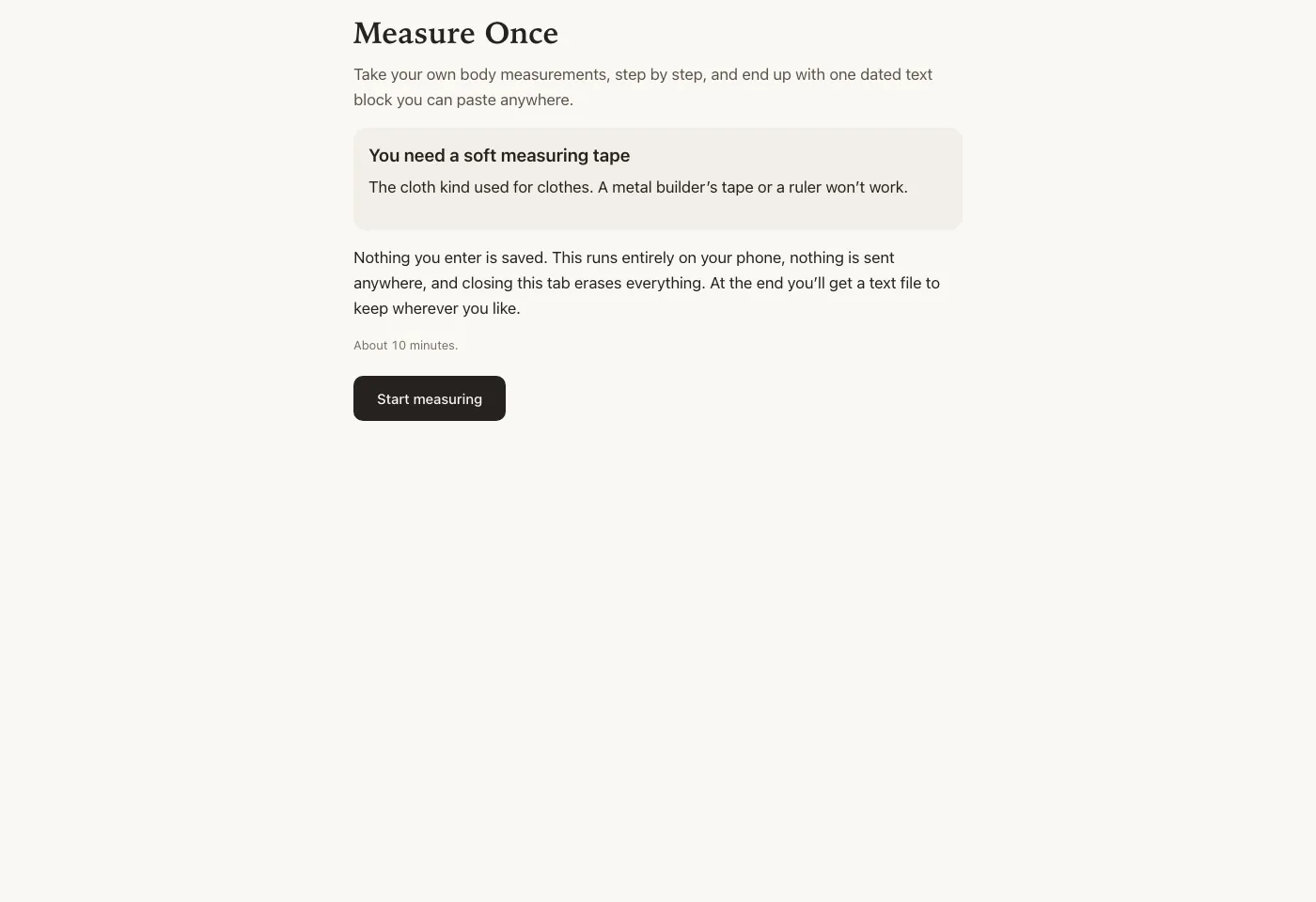
Measure Once is a free web app that walks you through eleven body and garment measurements, one at a time, and hands back a single dated text block in both centimetres and inches. Each step explains how to take that measurement accurately on your own with a soft tape. Nothing is saved — not on a server, not in your browser — so the exported text is the only record, ready to paste to a tailor or into a sizing form.
The problem people live around
Every tailor, sizing form and marketplace asks for the same measurements, and almost nobody has them written down in a form they trust. So they get re-taken, slightly differently each time, by someone guessing at where a waist is — and the results quietly disagree. That is how a carefully ordered garment still arrives wrong, and why the returns get blamed on the seller.
What Measure Once makes simpler
- Taking each measurement correctly, with an instruction for where the tape sits and how tight it should be, one screen at a time.
- Measuring on your own, without a second person — including the three measurements that genuinely can't be self-taken.
- Working in either unit, because every number comes back in centimetres and inches.
- Being understood downstream, because each number says whether it came off your body or off a garment that fits.
- Keeping the result, as one dated block of plain text you can paste anywhere.
What you can do now that was harder before
You can hand anyone — a tailor, a seller, a sizing form — one dated set of measurements you took properly, in both units, with each number labelled by the method that produced it.
How it works
The app is a guided sequence rather than a form. One measurement is on screen at a time, with an instruction for how to take it — where the tape sits, how tight it should be, how to use a mirror — so you're never guessing at what “waist” means halfway through.
Three of the eleven — shoulder, sleeve, and back length — can't be taken accurately on your own body, so they use the accepted alternative: lay a garment that already fits you flat and measure that. Every number in the export is labelled with which method produced it, because a garment measurement and a body measurement aren't interchangeable, and a tailor reading a bare list can't tell which is which.
There is no server behind it. Everything runs inside the browser tab, nothing is transmitted, and nothing is written to storage. The dated text block at the end is the only artefact that survives the session, and you decide where it goes.
What the AI does, and doesn't
None. There is no AI anywhere in Measure Once, and no server for one to run on. Nothing you type is interpreted, corrected, estimated, or compared against anyone else's measurements — the numbers that come out are exactly the numbers you put in, converted between units and labelled by method.
Evidence and sources
- Shoulder, sleeve and back length are taken from a flat garment rather than from your body.
- These three cannot be measured accurately on yourself without a second person, so the app uses the standard tailoring alternative — measuring a well-fitting garment laid flat — and labels every exported number with the method used, so the two are never confused downstream. As of August 2026
Limitations
Knowing where a tool stops is what makes the part that works trustworthy. These are written before launch, not after complaints.
- It doesn't save anything. No login, no database, no local storage, no analytics — close the tab and it's gone.
- It doesn't recommend a size. It gives you your numbers; matching them to a particular brand's chart is still your call.
- It isn't a body-composition or fitness tracker. There's no history, no chart, and no comparison over time.
- It can't measure from a photo. You need a soft measuring tape — the cloth kind used for clothes.
- Accuracy depends entirely on you following the instructions. The app has no way to detect a badly taken measurement.
Who it's for
- Anyone ordering from a tailor, in person or over chat, who keeps being asked for the same numbers.
- People buying clothes online across brands whose size charts disagree.
- Anyone who wants their measurements written down once, properly, without creating another account to hold them.
- Not a fit for tracking body change over time — there is deliberately no history.
What it does not replace
A tailor's own measuring, when one is available to do it. A professional measuring you in person will be more accurate than you measuring yourself, and Measure Once is for the situations where that isn't an option — remote orders, online sizing forms, and first conversations.
Why we built it this way
The fix isn’t a bigger app — it’s one careful pass. Take each measurement once, with an instruction for how to take it properly, record which method produced it, and end with a dated block of text you own.
Storing nothing was a design decision rather than a shortcut. There is no account to manage, no data to leak, and nothing to come back to. The output is plain text, which is the most portable format there is: it works in a chat window, a form field, a note, or on paper.
Questions about Measure Once
Do I need someone to help me take these measurements?
No. Measure Once is built around measuring yourself. Most of the eleven measurements are taken on your own body against a mirror, with instructions written for one person and one soft tape. The three that genuinely can't be self-taken — shoulder, sleeve, and back length — use a garment that already fits you, laid flat, instead.
Is anything I type saved or sent anywhere?
No. There's no login, no database, no local storage, and no analytics. The app runs entirely in your browser tab, nothing leaves your device, and closing the tab erases everything. The dated text block you export at the end is the only record that exists, and it exists only where you choose to paste it.
What do I need before I start?
A soft measuring tape — the cloth kind used for clothes, not a metal builder's tape or a ruler — and about ten minutes. A mirror helps for the body measurements. For the shoulder, sleeve, and back-length steps you'll also want one garment that already fits you well, to lay flat and measure.
Why does the export say how each measurement was taken?
Because a garment measurement and a body measurement aren't the same thing, and a list of bare numbers doesn't say which is which. Labelling each one stops whoever reads it downstream from treating a measurement taken off a shirt as a measurement taken off you — which is how a carefully taken set of numbers still ends up producing a bad fit.