
SuppsWise — evidence-graded supplement guidance for India
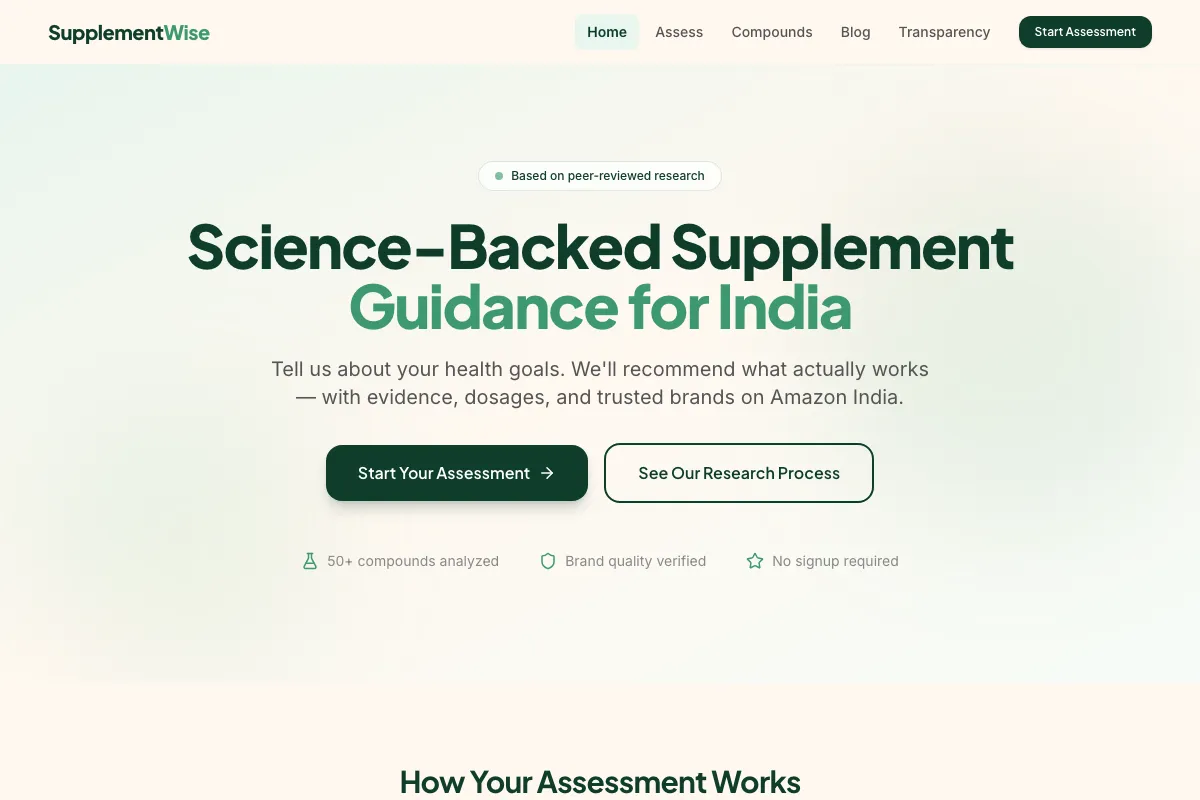
SuppsWise is a free web app that turns a short health assessment into a specific supplement shortlist for the Indian market, showing the evidence grade, the trial-derived dosage and the safety flags next to each recommendation. Every compound is graded strong, moderate, emerging or traditional, and that grade is displayed rather than implied. It runs on Amazon India affiliate commission, states so openly, and commission rate is not an input to the ranking.
The problem people live around
The Indian supplement market runs on marketing rather than evidence. The choice on offer is a brand's own claims against a forum thread, and neither tells you whether a compound has actually been tested in humans, at what dose, or what it shouldn't be combined with. So people spend money on things that don't work, at doses that wouldn't have worked anyway, and occasionally on combinations they should have been warned about.
What SuppsWise makes simpler
- Narrowing the field, by turning your goals, current supplements and conditions into a shortlist rather than a catalogue.
- Judging how much to trust a claim, because every compound shows its evidence grade — strong, moderate, emerging, or traditional — beside the recommendation.
- Knowing what dose is meaningful, since dosages come from the clinical trials rather than the product label.
- Avoiding a bad combination, because compounds contraindicated by the conditions you entered are removed before anything is ranked.
- Knowing when to stop, because it says how long to take something before reassessing rather than implying it is forever.
- Understanding the incentive, since the revenue model is published on the product's own transparency page.
What you can do now that was harder before
You can see, before spending anything, which compounds have human trial evidence behind them for your stated goals, how strong that evidence actually is, what dose the trials used, and what each one interacts with.
How it works
The recommendation engine is a rules-based scoring system. Your stated goals map to candidate compounds with fixed relevance weights, that score is adjusted by the compound's evidence grade — strong counts for more than emerging, which counts for more than traditional use — and anything contraindicated by the conditions you entered is removed before anything is ranked.
The data underneath is compiled by hand. Each compound goes through a literature review of human clinical trials rather than animal or in-vitro studies, an evidence grading, a dosage calibration taken from those trials, and a safety screen for contraindications and interactions drawn from medical databases and regulatory sources.
Monetisation is kept structurally separate from ranking. The site earns an Amazon India affiliate commission, publishes that on its own transparency page, and takes no ads, no paid placements and no revenue from data. Commission rate is simply not one of the scoring inputs.
What the AI does, and doesn't
None. The recommendation engine is a rules-based scoring system, not a language model — the same inputs always produce the same shortlist, and you can read the rules rather than trust a black box. No text is generated per visit, no model interprets your health information, and nothing you enter is used to train anything.
Evidence and sources
- Compounds are graded strong, moderate, emerging or traditional, and dosages come from clinical trials rather than manufacturer labels.
- Published methodology: a literature review of human clinical trials (not animal or in-vitro studies), prioritising randomised controlled trials and systematic reviews; evidence grading; dosage calibration taken from those trials and adjusted for Indian body weights and dietary patterns; and a safety screen for contraindications and interactions compiled from medical databases and regulatory sources. Source ↗ · As of March 2026
- Affiliate commission does not influence what gets recommended.
- The revenue model is published in full on the product's own transparency page: Amazon India affiliate commission is the only source, with no user charges, ads, paid brand placements or data sales, and commission rate excluded from the scoring inputs. Brand selection runs on separate published quality criteria. Source ↗ · As of March 2026
Limitations
Knowing where a tool stops is what makes the part that works trustworthy. These are written before launch, not after complaints.
- It works from what you tell it, not from bloodwork. Nothing is personalised by an actual test result.
- Evidence grades summarise a body of research that is often mixed. A “moderate” grade means the picture is genuinely unsettled, not that a decision has been made for you.
- Coverage is a curated compound set, not every supplement sold in India.
- It doesn't sell anything itself, hold payment details, or ship a product — purchase happens on Amazon.
- A compound with only traditional use is labelled that way rather than presented as established, which means some popular products will look weaker here than in their own marketing.
Who it's for
- People in India deciding whether a supplement is worth buying at all.
- Anyone who wants the evidence grade and the trial dose before the product recommendation.
- People already taking supplements who want to check for interactions they weren't told about.
- Not for anyone managing a diagnosed condition or on prescription medication without a doctor in the loop.
What it does not replace
A doctor, a pharmacist, or a blood test. SuppsWise summarises what human trials suggest and flags what a compound interacts with. It does not know your medications, your history or your bloodwork, and it cannot tell you whether something is safe for you specifically — that judgement needs a clinician.
Why we built it this way
The response to a market that runs on claims is to publish the reasoning, not just the answer. Every compound carries a visible evidence grade, dosages come from the trials rather than the label, contraindications are screened before anything is ranked, and the way the product earns money is written down on its own page.
A recommendation you can audit is worth more than one you have to trust. That principle costs something: compounds with strong marketing and thin evidence look worse here than they do anywhere else you might read about them, and some of them sell very well.
Questions about SuppsWise
Is SuppsWise medical advice?
No. It's an evidence summary and a shortlist, not a prescription. It can tell you what human trials suggest for a goal, at what dose, and what a compound interacts with — but it doesn't know your bloodwork, your medications or your history. If you're on prescription medication, pregnant, or managing a diagnosed condition, take the shortlist to a doctor rather than acting on it.
How does SuppsWise make money, and does that change what it recommends?
It earns an affiliate commission when you buy through an Amazon India link, and that is the only revenue source — no user charges, no ads, no paid brand placements, no data sales. Commission rate isn't an input to the ranking: recommendations are scored on your goals and the strength of the evidence, and brands are selected on quality criteria published on the site.
What does an evidence grade actually mean?
Strong means multiple randomised controlled trials with consistent results. Moderate means limited RCTs or strong observational data. Emerging means preliminary research that looks promising but isn't conclusive. Traditional means Ayurvedic or long-standing use without modern trials. The grade sits next to the recommendation so a traditional compound never reads as a proven one.
Are the dosages the same as what's printed on the bottle?
Not necessarily. Dosages come from the clinical trials the evidence grade is based on, not from manufacturer labels or marketing claims, and they're adjusted for Indian body weights and dietary patterns. Where a compound should only be taken for a limited period before reassessing, the app says how long rather than implying it's indefinite.