
Blindspot — a short game that trains you to spot your own thinking errors
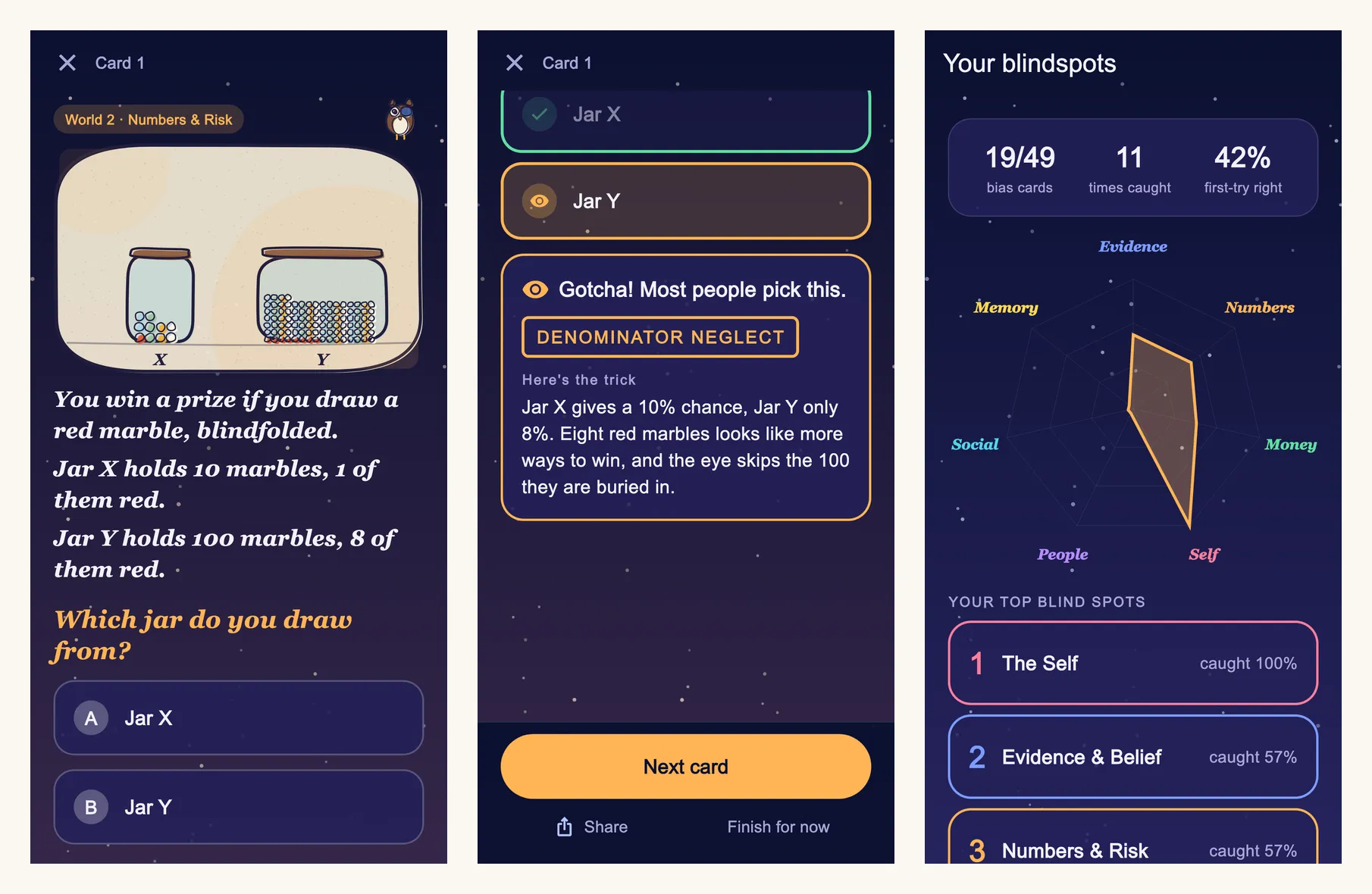
Blindspot is a free Android app that trains you to notice 49 common thinking errors by letting you fall for them first. Each card is a 20-second story with two answers, built so the tempting one is the biased one. You then see what was hidden, which bias it was, and one habit that guards against it. A session is three to five cards, there is no account or advertising, and it works offline.
The problem people live around
Almost everyone has read that confirmation bias or the sunk-cost fallacy exists, and almost no one catches themselves doing it. Knowing the name of a thinking error is not the same as noticing it in the moment, and lists of biases read as trivia about other people. Because the error feels like good judgement while it is happening, you only learn to see it by being caught — which is rarely safe, and rarely comes with an explanation.
What Blindspot makes simpler
- Seeing a bias in practice rather than as a definition, because each card is built so the tempting answer is the biased one.
- Being caught without being judged — nobody is told they are wrong, and most people pick the same answer.
- Remembering what to do about it, since every card ends with a single one-line habit.
- Knowing where you are prone to slip, through a profile that shows which of the seven kinds of mistake catch you most.
- Fitting it into the day, with sessions of three to five cards that work offline, with or without sound.
What you can do now that was harder before
You can recognise a specific thinking error as it happens, name it, and reach for a simple habit that guards against it — because you have already fallen for it once in a place where it cost nothing.
How it works
Each card is a tiny story with a question and two answers. You read it, pick one, and the app shows you what happened. If you chose the tempting option, you see a 'what was hidden' reveal that names the bias and explains the trick. If you chose the other, you see why that option works. Either way, the card ends with the same single habit to take away.
The 49 cards are spread across seven worlds of seven biases each: Evidence & Belief, Numbers & Risk, Money & Value, The Self, Judging People, Social Pull, and Memory, Time & Change. Every bias you meet lights a star on a night-sky map, builds a library of what you have seen, and feeds a profile showing which kinds of mistake catch you most. A daily streak with a weekly freeze, XP and levels from Sleepwalker to Clear-eyed keep track of progress, with no lives, hearts or penalties.
Everything runs on your phone. There is no account, no internet connection and nothing sent anywhere. Your progress — cards played, answers, XP, streak and settings — is stored on the device and can be erased in Settings. If you share a takeaway, it is turned into an image and handed to Android's share sheet, and you choose where it goes.
What the AI does, and doesn't
None. There is no AI in Blindspot. The 49 scenarios, their reveals and the habits that go with them were written in advance, the illustrations and sounds are original works, and nothing you answer is analysed, scored by a model or sent anywhere.
Limitations
Knowing where a tool stops is what makes the part that works trustworthy. These are written before launch, not after complaints.
- It builds awareness and a shared vocabulary for thinking errors. It does not prove that knowing about a bias stops you committing it.
- It is a fixed set of 49 scenarios, so a regular player will meet each card more than once.
- All scenarios are hypothetical, and a few are modelled on well-known published experiments rather than reporting them.
- It is an Android app on Google Play. There is no web or iPhone version yet.
- It gives no financial, medical or psychological advice, and it doesn't assess you — the profile reflects only the cards you have played.
Who it's for
- Anyone curious about how their own thinking goes wrong, who would rather feel it than read a list.
- People who make decisions about money, risk or people and would like a few quick habits to check themselves.
- Students and anyone learning to reason about evidence, numbers and claims.
- Not for children — it is written for adults (18 and over) — and not a replacement for formal training in statistics or critical thinking.
What it does not replace
A course in statistics, logic or critical thinking, or advice from a professional about a real decision. Blindspot gives you a shared vocabulary and a handful of habits for common thinking errors. It does not teach the underlying maths, and it does not tell you what to decide.
Why we built it this way
Most advice about thinking errors is delivered like a warning: here is a list, don’t do these. That fails for a simple reason — a bias feels like good judgement from the inside, so a list gives you nothing to recognise it with.
Blindspot is built the other way round. It lets you make the mistake in a story where nothing is at stake, then shows you precisely what you missed. Being caught is the lesson, so the app is gentle about it: no lives, no penalties, and a reminder that most people choose the same answer. The aim is not a perfect score. It is that the next time a tempting answer shows up in real life, it feels a little familiar.
Questions about Blindspot
What is Blindspot and how does it work?
Blindspot is an Android game that trains you to notice common thinking errors. Each card is a short story with two answers, built so the tempting one is the biased one. After you choose, it shows what was hidden, names the bias and gives one habit to guard against it. A session takes three to five cards, and nobody is told they are wrong.
Is Blindspot free, and does it need an account or internet?
It is free, with no account, no sign-up and no advertising. It also works completely offline — the app asks for no internet access and no special permissions. Your progress, such as the cards you have played, your XP and your streak, stays on your phone, and you can erase it at any time in Settings.
Which thinking errors does Blindspot cover?
It covers 49, in seven worlds of seven each: Evidence & Belief, Numbers & Risk, Money & Value, The Self, Judging People, Social Pull, and Memory, Time & Change. They include confirmation bias, anchoring, sunk cost, survivorship bias, the planning fallacy, the halo effect and hindsight bias, among others.
Is there a version for iPhone or the web?
Not yet. Blindspot is currently available only as an Android app on Google Play. If that changes, this page will say so. Everything it does is stored on the device, so there is no account to move between phones, and progress does not carry over to a new device.