
Brain Gym — structured workouts for how you think
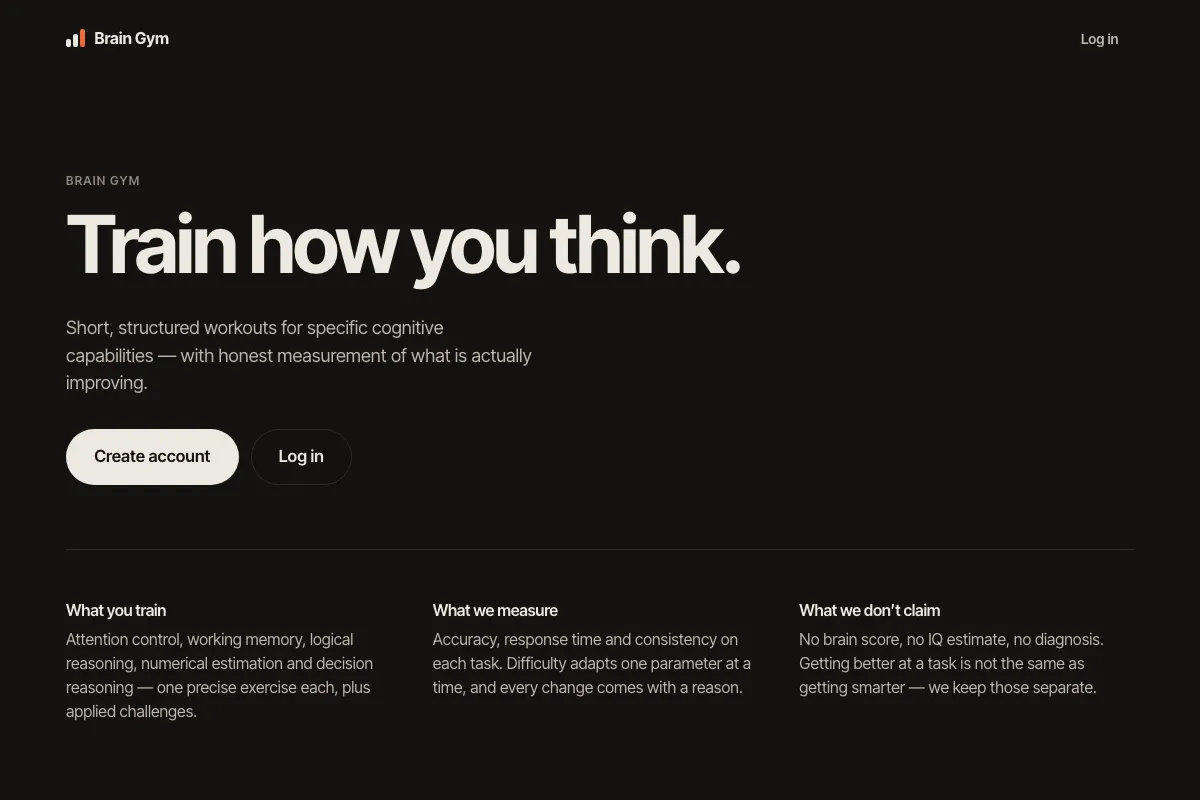
Brain Gym is a free web app that turns cognitive training into something closer to physical training: a baseline, short structured workouts, difficulty that rises and falls with your performance, and periodic reassessment. It trains five capabilities — attention control, working memory, logical reasoning, numerical estimation and decision reasoning — each with one precise exercise, plus applied challenges drawn from everyday situations. It reports ranges with a confidence level, never a single brain score or IQ estimate.
The problem people live around
Physical training has exercises, sets, progressive overload and personal records. Training how you think has puzzle apps, IQ tests and games that promise to make you smarter and never show what changed. Someone who wants to get sharper at reasoning or holding things in mind has no straight answer to the first question — what should I actually practise — and no honest way to tell whether it is working.
What Brain Gym makes simpler
- Knowing what you are training, because each exercise targets one named capability rather than a vague 'brain'.
- Training at the right difficulty, because it adjusts after every few sets and records the reason for each change.
- Seeing what is actually improving, as a range with a confidence level instead of a flattering single number.
- Telling practice apart from progress, because training results and assessment results are kept separate.
- Using it in real life, through applied challenges — comparing prices, reading a forecast, spotting a misleading claim.
What you can do now that was harder before
You can deliberately practise a specific way of thinking at the right difficulty, and see — with its uncertainty stated — whether you have improved at that task, without being told you have become smarter.
How it works
You start with a baseline that finds your level on each exercise, and can pause and resume it. From there a workout generator builds short sessions — warm-up, a primary block, a secondary block and an applied challenge — weighted towards your goal, with no single capability allowed more than 35% of a session. The five exercises are Signal Filter for attention, Sequence Span for working memory, Valid Conclusions for logical reasoning, Closest Estimate for estimation, and Odds & Evidence for decision reasoning.
Each set is scored on accuracy, speed and consistency. Difficulty rises one level after three strong sets and drops after two weak ones, and every level changes exactly one parameter, so you always know what got harder. Responses given while the tab was hidden, or too fast to be real, are left out of scoring rather than counted. Reassessments use fixed levels and fresh items, so a gain reflects the capability rather than memorised answers.
Your account and all training data live in your own browser. There is no server: the password is hashed before it is stored locally, nothing is transmitted, and you can view everything held about you, export it as a file, or delete it from the profile screen.
What the AI does, and doesn't
None. There is no AI in Brain Gym. Exercises are generated deterministically from fixed, versioned rules, the logic items were checked by hand and are covered by tests, and difficulty changes follow published thresholds. Nothing you do is sent anywhere to be analysed, and no part of your results is written by a model.
Evidence and sources
- Getting better at a trained task does not by itself mean a broad improvement in intelligence.
- Research on brain training has repeatedly found improvement on practised tasks with weak or inconsistent transfer to untrained abilities. Brain Gym is designed around that finding: it reports progress per task, keeps training and assessment separate, and makes no claim of general cognitive gain. As of September 2026
- Adaptation thresholds, scoring weights and estimate ranges are starting values.
- They were set by design rather than calibrated on real users. Calibrating them against a larger group of users is planned work, not finished work. As of September 2026
Limitations
Knowing where a tool stops is what makes the part that works trustworthy. These are written before launch, not after complaints.
- It does not make you smarter in general, and it does not claim to. It measures whether you got better at what you practised.
- It gives no brain score, no IQ estimate and no diagnosis of any condition.
- Everything is stored in one browser. There is no password reset by email, no sign-in with Google, and no sync across devices yet — clear your browser data and your history goes with it.
- Thresholds and weights are starting values that have not yet been calibrated on real users.
- Recall is not trained yet. The current exercises cover attention, working memory, reasoning, estimation and decisions.
Who it's for
- People who want to practise reasoning, estimation or holding information in mind as a deliberate routine, not a game.
- Anyone sceptical of brain-training claims who wants measurement that states its own limits.
- People who like to see why difficulty changed, not just that it did.
- Not for assessing or treating a cognitive condition, and not a tool for anyone else to judge you by.
What it does not replace
A clinician, a neuropsychological assessment, or treatment for any cognitive or memory concern. If you are worried about your memory, attention or thinking, that is a conversation for a doctor. Brain Gym is training and education, not medical care.
Why we built it this way
Most brain-training products are built backwards: a single score that goes up, framed as a mind getting sharper. That feels good and says very little, because improving at a game mostly means improving at that game.
Brain Gym takes the gym model literally and stays honest about what it can show. Each exercise trains one named capability, each difficulty step changes one thing, and each result comes with the uncertainty around it. The claim is kept small on purpose — you got better at this task, by roughly this much — because that is the claim the evidence supports.
Questions about Brain Gym
Will Brain Gym make me smarter?
It won't claim to. Brain Gym measures whether you improve at the specific tasks you practise — attention, working memory, reasoning, estimation and decisions — and states that improvement as a range with a confidence level. Research on brain training generally finds gains on trained tasks with weak transfer to intelligence as a whole, so Brain Gym keeps those two ideas deliberately separate.
Do I need an account, and where is my data kept?
Yes, you create an account — but it lives only in your own browser. There is no server: your password is hashed and stored locally alongside your training data, and nothing is sent anywhere. The trade-off is that there is no email password reset or cross-device sync yet. You can view, export or delete your data from the profile screen.
How does the difficulty change?
One step at a time, with a reason. Difficulty goes up after three strong sets in a row and down after two weak ones, and each level changes exactly one thing — a longer sequence, more distracting arrows, a harder argument. If you have been away for three weeks or more, it recalibrates rather than assuming you are where you left off.
Is Brain Gym a medical or diagnostic tool?
No. It gives no diagnosis, no brain score and no IQ estimate, and it is not designed to detect or treat any condition. It is cognitive training and education. If you have concerns about your memory, attention or thinking, speak to a doctor rather than relying on your results here.