
Possibilities — ten worthwhile things you could do right now
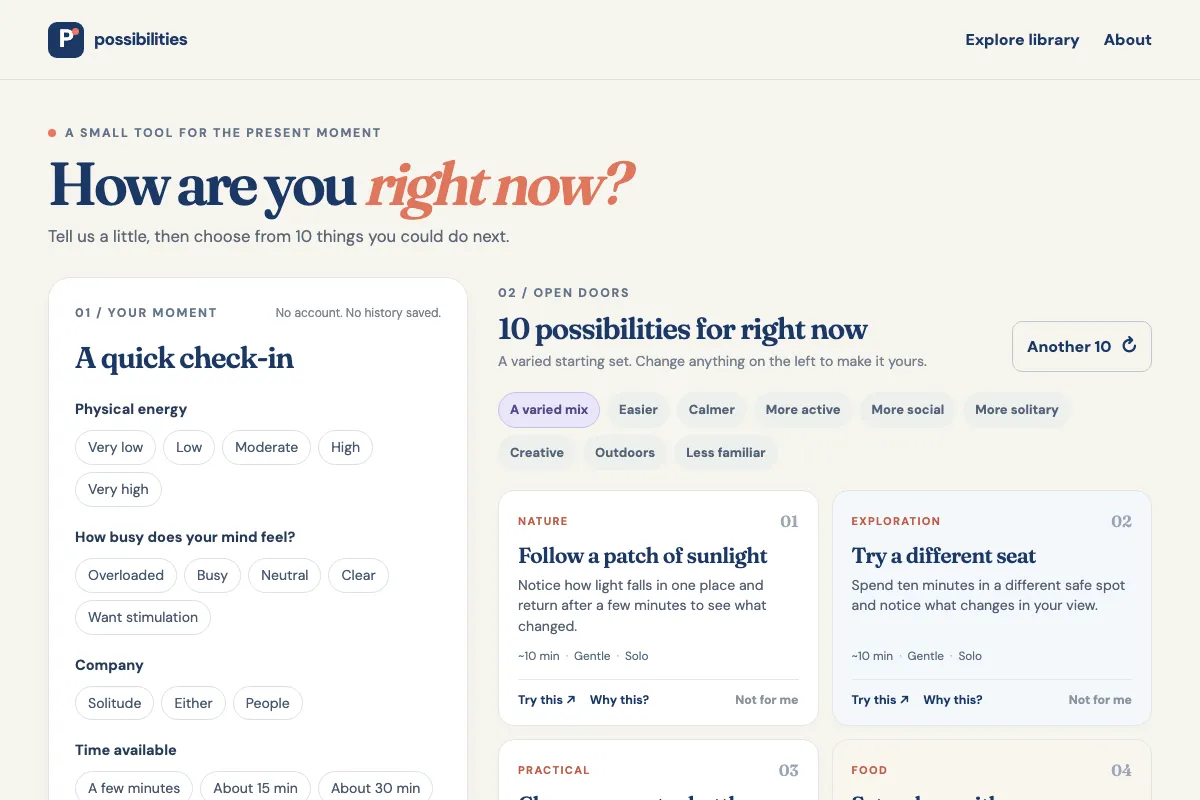
Possibilities is a free web app that asks how you are right now — your physical energy, how busy your mind feels, whether you want company, and how much time you have — and suggests ten varied things you could do next. The ideas come from a hand-written library of 150 activities across 15 areas, from movement and rest to music, food and helping someone. Nothing is saved, there is no account, and you choose what fits.
The problem people live around
Having nothing to do is rarely the problem. There is music, walking, people to call, things to make, places to go. But when you're tired, flat, restless or overloaded, the options that would actually suit you are hard to think of, and the easiest thing to hand — usually a screen — wins by default. Most apps that try to help either want your attention every day or treat how you feel as something to track.
What Possibilities makes simpler
- Thinking of something worth doing when you're too tired, flat or busy-minded to come up with it yourself.
- Matching an idea to your state, because energy, time, company and where you are all shape what appears.
- Seeing real variety, since the ten ideas are spread across different areas instead of ten versions of one thing.
- Understanding a suggestion, because 'Why this?' says which of your answers it fits.
- Getting on with it, as each idea comes with a time, what you'll need and a few simple steps — then the app gets out of the way.
What you can do now that was harder before
You can go from not knowing what to do with the next half hour to a short list of realistic, varied things that suit how you actually feel — without logging your mood, making an account or being nudged to come back.
How it works
The check-in asks four things: physical energy, how busy your mind feels, whether you want solitude or people, and how much time you have. Optional extras cover what you're feeling, how much effort is available, where it could happen, and access preferences such as staying seated, avoiding strenuous movement, low sensory input, no audio or no reading. You can answer as much or as little as you like, or press 'Surprise me'.
Your answers first rule out what doesn't fit — anything longer than your available time, activities that need other people when you asked for solitude, or strenuous ones if you asked to avoid them. The rest are ranked with simple, written rules: closer matches on energy and effort score higher, and feeling lonely favours activities with someone. The ten are then picked so no single area dominates. 'Another 10' gives a fresh set, 'Not for me' swaps one card out, and chips like Calmer, Outdoors or Less familiar steer the next set.
Every idea comes from a library of 150 activities, written by hand across 15 areas: movement, rest, creation, connection, learning, play, nature, practical tasks, music, food, reflection, contribution, exploration, sensory experiences and culture. The whole library can be browsed and searched. Your check-in is never saved or sent anywhere — close the page and it's gone.
What the AI does, and doesn't
None. There is no AI in Possibilities. Every activity was written by a person in advance, and the app never invents one. Suggestions are chosen with fixed, written rules that compare your answers to each activity's time, energy, company and setting. Nothing you enter is sent anywhere to be analysed.
Evidence and sources
- Every suggestion comes from a fixed, hand-written library of 150 activities, and the app never generates new ones.
- The library is a static file of 150 entries, ten in each of 15 areas, each with a time estimate, energy level, company, setting, materials, and access and safety notes. It can be browsed in full from 'Explore library'. As of September 2026
- Your check-in is not stored or transmitted.
- The app keeps your answers in memory only, writes nothing to browser storage, and makes no network requests with them. The hosting provider's standard page-view analytics are loaded, but they never receive your check-in or the ideas you're shown. As of September 2026
Limitations
Knowing where a tool stops is what makes the part that works trustworthy. These are written before launch, not after complaints.
- It doesn't diagnose, track your mood, or tell you what you should do. It offers ideas; you decide.
- The library holds 150 activities. It's a starting set, and some ideas will repeat if you ask for many rounds.
- It's English-only, and some ideas assume things not everyone has — a safe outdoor space, a person to talk to, or music to hand.
- Matching is rough by design. It can't know what an activity would really feel like for you on a given day.
- It remembers nothing between visits, so it won't learn your preferences over time.
Who it's for
- Anyone with some free time and no idea what to do with it, especially when tired, restless or low.
- People who'd like a nudge away from their phone without another app asking for their attention every day.
- People who want ideas that respect limits — staying seated, low noise, no reading, little energy.
- Not for anyone in crisis or needing mental health support. Possibilities offers everyday ideas, not help or treatment.
What it does not replace
A doctor, therapist, counsellor or crisis service. Possibilities suggests everyday activities that suit how you feel in the moment. It does not assess or treat anything, and if you're struggling, talking to a professional or someone you trust matters more than any idea here.
Why we built it this way
Most apps that ask how you feel want to keep asking. They log your mood, chart it and send reminders, turning a passing state into a record. Possibilities asks once, offers ten ideas and then expects you to close it. “Find a possibility. Then go live it” is the whole design brief.
That’s why nothing is saved and there are no streaks, and why the library is written by hand rather than generated. Each idea is real, small and doable now, and the rules that pick them are simple enough to explain in one sentence. The app’s job is to widen your options for the next half hour, then get out of the way.
Questions about Possibilities
What does Possibilities ask, and how long does it take?
Under a minute. It asks about your physical energy, how busy your mind feels, whether you want company, and how much time you have. You can add what you're feeling, how much effort is available, where you are, and access needs, but all of it is optional. Or press 'Surprise me' and skip the check-in entirely.
Where do the ideas come from?
From a library of 150 activities written by hand, ten in each of 15 areas such as movement, rest, music, food, nature and helping others. Nothing is generated by AI. Written rules match the library to your answers and spread the ten ideas across different areas. You can browse and search the whole library from 'Explore library'.
Can Possibilities help with anxiety or low mood?
It isn't designed to. Possibilities can suggest gentle, realistic things to do when you feel low or restless, but it doesn't assess, track or treat how you feel. If low mood or anxiety is affecting your life, please speak to a doctor or mental health professional, or a crisis line if you're in immediate difficulty.