
Reset — a short checkup that turns everyday loose ends into a few actions
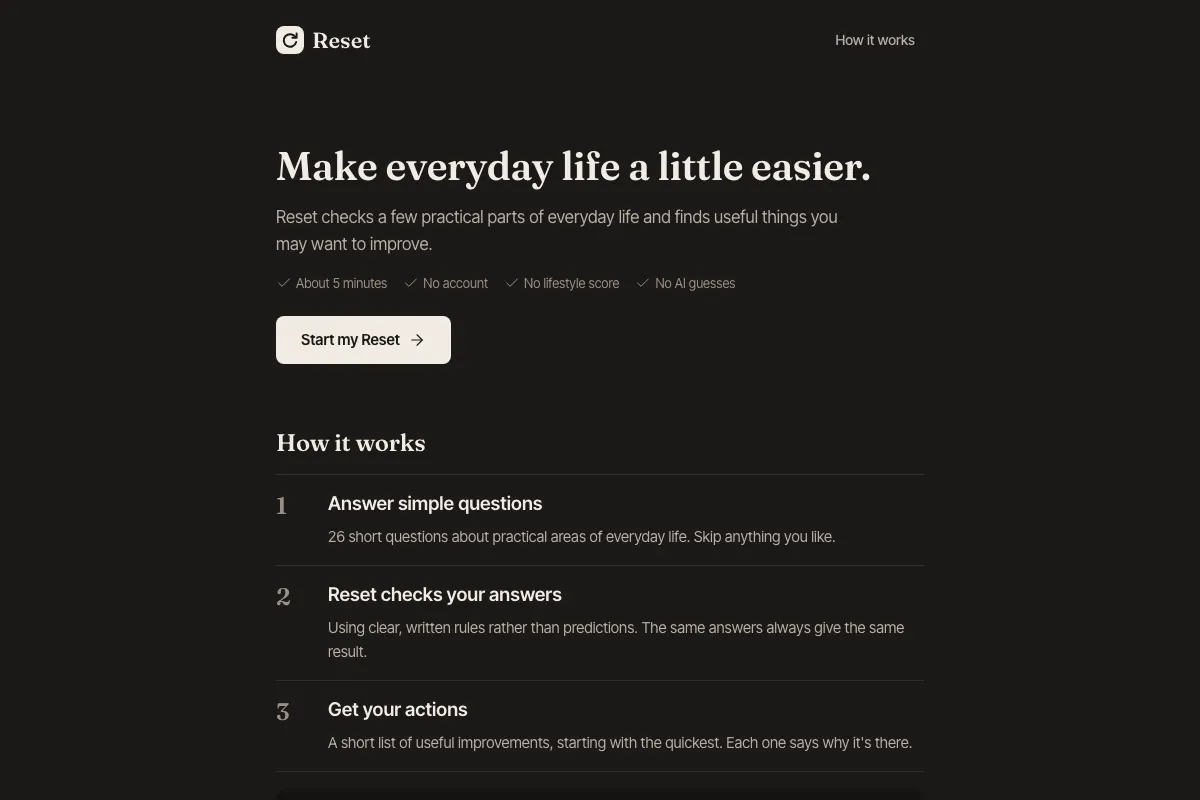
Reset is a free web app that asks 26 short questions about the practical side of everyday life — digital safety, money, important documents, home admin, preparedness and repeated friction — and returns a small, prioritised list of actions, quickest first. Each action says why it's there and gives simple steps. It takes about five minutes, uses written rules rather than predictions, gives no score, and keeps your answers in your browser.
The problem people live around
Most people know, vaguely, that some things aren't sorted: a password used everywhere, a backup that may not be running, subscriptions nobody has looked at, documents that would take an hour to find. None of it is urgent until the day it is. The difficulty isn't doing any one fix — most take minutes — it's knowing which ones apply to you and where to start, without a long guide or someone else going through your affairs.
What Reset makes simpler
- Knowing where to start, because the list is sorted by effort and opens with the quickest wins.
- Trusting a suggestion, because each one names the answer that led to it.
- Actually doing it, with short steps and a rough time for each action instead of a general article.
- Being honest about what you don't know, since 'Not sure' leads to a quick check rather than an assumed problem.
- Keeping the result, as a checklist you can copy or print.
What you can do now that was harder before
You can find out, in about five minutes and without handing your details to anyone, which small practical fixes actually apply to your life — and start with the ones that take the least effort.
How it works
You answer 26 short questions across six areas: digital safety, money clarity, important documents, home and everyday admin, preparedness, and time lost to repeated friction. Anything can be skipped or marked as not applying, and one question only appears when an earlier answer makes it relevant. Reset never asks for passwords, ID numbers or bank details.
Your answers are checked against explicit, written rules. Each rule links an answer to a recommendation and carries its own reason, so the same answers always produce the same plan. A skipped question never triggers anything, and 'Not sure' can only lead to a check, never to an assumed fix. Actions are grouped by effort — Do now, Do this week, Worth considering — and the main plan never holds more than seven. Anything beyond that goes under 'More things you could improve', and what you already have sorted is listed as 'Already in place', without a score.
There is no backend and no analytics. Answers, completed items and dismissed items are kept in your browser, nothing is sent to a server, and 'Clear my Reset' removes all of it.
What the AI does, and doesn't
None. There is no AI in Reset. Every recommendation comes from a written rule that links a specific answer to a specific action, and every rule states its own reason. Nothing is predicted, scored or inferred, and nothing you answer is sent anywhere to be analysed.
Evidence and sources
- The same answers always give the same plan.
- The rule evaluator is a pure function with no randomness and no network calls, and fixed test profiles check the exact recommendations each one produces. Rules and questions are versioned, and the version is stored with your answers. As of September 2026
Limitations
Knowing where a tool stops is what makes the part that works trustworthy. These are written before launch, not after complaints.
- It covers a fixed set of practical areas. It isn't a full audit of your finances, security or home.
- It gives no medical, legal, tax or investment advice, and doesn't try to.
- It only knows what you tell it. It can't check whether your backup actually runs or your passwords are actually different.
- Recommendations are general. They don't account for your country, bank, phone or provider beyond what the steps describe.
- It doesn't remind you later. Your plan stays in this browser until you clear it, but it won't send you anything.
Who it's for
- Anyone with a sense that some practical things aren't sorted, who wants a short list rather than a long guide.
- People setting up on their own for the first time — a new home, a new city, a first job.
- Anyone who wants to help a parent or relative get organised, one small action at a time.
- Not for people who want a score or a comparison with others — Reset gives neither.
What it does not replace
A financial adviser, a lawyer, an accountant or an IT security professional. Reset points out small, general fixes that most people benefit from. It doesn't review your specific situation, and it doesn't replace advice from someone who can.
Why we built it this way
Life-admin advice usually comes as a long article or a list of fifty tips, most of which don’t apply to you. Reset does the opposite: a few questions, then only the handful of actions your answers actually point to, starting with the ones that take two minutes.
The rules are written down rather than predicted, and each one explains itself, so you can see exactly why an action is there and disagree with it. Keeping the plan short was deliberate. A list of seven things you might do this week is more useful than a complete audit you’ll never finish.
Questions about Reset
What does Reset ask about, and how long does it take?
About five minutes. Reset asks 26 short questions across six practical areas: digital safety, money clarity, important documents, home and everyday admin, preparedness, and time lost to repeated friction. You can skip any question or mark it as not applying, and it never asks for passwords, ID numbers or bank details.
Is anything I answer saved or sent anywhere?
Nothing is sent anywhere. There is no account, no server and no analytics. Your answers, and the actions you mark as done or dismiss, are kept in your own browser so you can come back to them. Choosing 'Clear my Reset' removes everything.
Why don't I get a score?
Because a score wouldn't help you do anything. Reset's job is a short list of useful actions, each with the reason it's there. What you already have sorted is shown as 'Already in place', without a number and without comparing you to anyone else.
How does Reset decide what to recommend?
With written rules, not predictions. Each rule links a specific answer to a specific action and explains why. The same answers always give the same plan, skipped questions never trigger anything, and 'Not sure' only ever leads to a quick check. Actions are ordered by effort, so the quickest come first.